Pineapple Crab Animatronic
(Present)
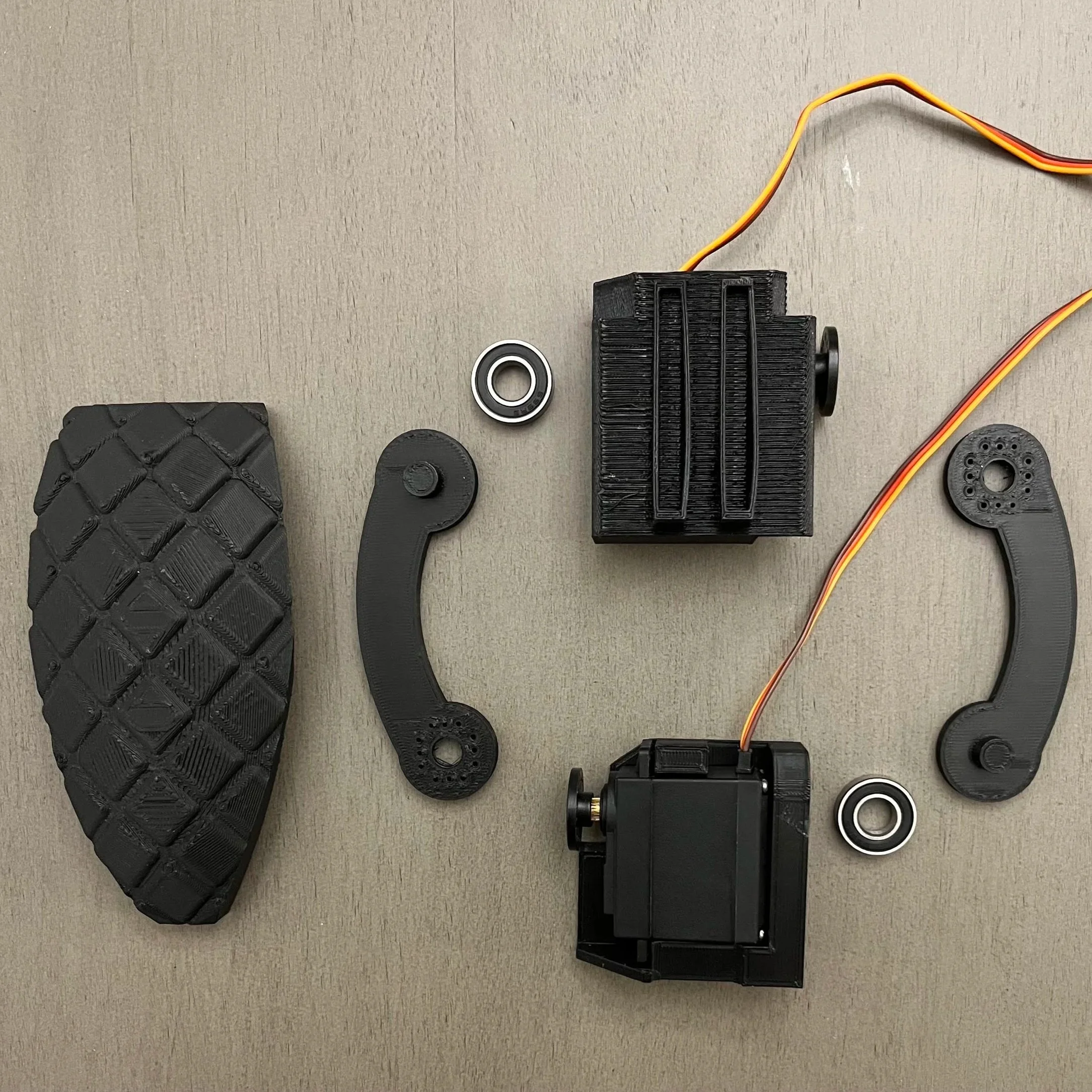
Early leg rendering (left) and components (right) prototype of pineapple crab animatronic
I had an idea that heavily stems from the Hasbro toy line Transformers, having a seemingly organic item transform into an creature that can interact with its environment in a playful manner, like a child making discovering everything for the first time. My object choices were limited by size, as I wanted it to fit on a desk but still have enough room to fit all the electrical components without sacrificing as much articulation as possible. Ultimately, I decided on a pineapple, which has a complex organic exterior that would be complicated to mimic but would allow the edges of non-connected parts to hide easier in the cracks and crevasses of the fruit’s skin.
My early designs had the unfolded pineapple resembling a crab, which fits with a more tropical beachy environment the creature could naturally be found in thematically. While planned to have 4 to 6 legs to mimic a more crab-like appearance while also providing more mobility and articulation, I was quickly running into internal space issues as the pineapple core shell volume was already designed to be larger than the average from the sample size collected. I decided to maximize on the performance a single leg, going for larger servos at the hip and knee joints that could handle more torque. Put simply, I had no idea at the time how much weight each leg may need to support, as I was planning for the animatronic to be portable meaning every component would need to be self contained, so I decided to air on the side of caution mechanically rather than visually. This decision led to the 3 legged crab design.
The animatronic is being modeled using Solidworks. Once I finish puzzle piecing each component to fit inside the pineapple core, I could use Solidworks built in Finite Element Analysis to make improvements on the design, especially with reinforcing the maximum load each leg can hold as I foresee that being my main issue with this animatronic. The current animatronic design utilizes 7 servos, one for each leg’s hip and knee joint with the extra allowing the eyes to yaw left and right. There is also a DC motor inside that will raise and lower the top of the pineapple core, effectively becoming a shell for the crab. The whole animatronic is powered using a rechargeable 12V battery pack, passed through a 5V step down voltage regulator, and programmed using an ESP32 as a micro controller. Originally, an Arduino nano was used as a microcontroller, but this was changed in favor of the ESP32’s built in Wi-Fi and Bluetooth capabilities using ESP-NOW. This allowed me to use an additional ESP32 connected with a joystick to puppet certain parts of the animatronic at a time, in hopes of developing this aspect further for custom live interactions with an audience.
All parts are being fabricated using a 3D printer with PLA filament, mostly because this is the only manufacturing process I have easy access to at this time. This allows for these parts to have an intricate geometry that normal manufacturing methods can not replicate easily, meaning more space for additional components inside the core. Admittedly, some parts may need to be adopted to traditional subtractive manufacturing methods if PLA is not strong enough to handle some of the loads applied, but in turn would increase the total weight of the animatronic which I want to keep at a minimum.
In its current form, I have designed, manufactured, and tested the lower half of the core, which appears to be working successfully. I am experimenting with Bottango at the moment to have controlled animations of the animatronic, just to test how I want it to express feeling excited, frightened, angry, etc. This project is still actively in development and still has many challenges I have not quite figured out yet, but I am progressively getting closer to a final prototype and can not wait to show off the final product soon.
Automated Tire Scrapper assembly drawing (exploded view)