Portfolio
Throughout my education, I was able to work on projects related to my academics, extracurriculars, and for personal means, with each one was able to teach me valuable lessons through out the experience that I carry with me now. These projects also helped to define the work I produce in my professional career.
Learn more about my projects and experiences below.
Academic Projects
AT-ST Action Toy (2023)
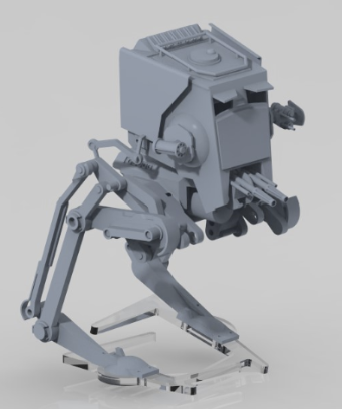
As apart of ME 444, also known by students as Toy Design, the final project of the class was to create an action toy that included a minimum of 2 motion features utilizing manufacturing methods learned in class such as additive manufacturing and laser cutting. A team consisting of three students and myself decided to make a bipedal walker based off of a vehicle from the Star Wars franchise called an AT-ST (All Terrain Scout Transport). The AT-ST had one motor that rotated a belt attached to the leg shaft, which is how each leg was able to complete its walking motion. At the end of the right leg was a ball joint connecting to the cockpit of the AT-ST, giving it a swivel motion similar to what appears in Star Wars media. The entire toy was modeled in Creo, including linkage animation and FEM, and was produced mainly using a 3D printer with the addition of laser cut acrylic foot pads.
My main contribution to this project was modeling the cockpit of the AT-ST and understanding how to combine practicality of scale, space, and functionality while staying as accurate to the source material as possible. If this prototype was to move further into production, our team would want to reassess the weight distribution and materials used, as after a few hours of demonstration the walking became increasingly strained.
At the end-of-course presentations, our toy received the “Best Marketing Potential” award.
Automated Tire Scraper (2024)
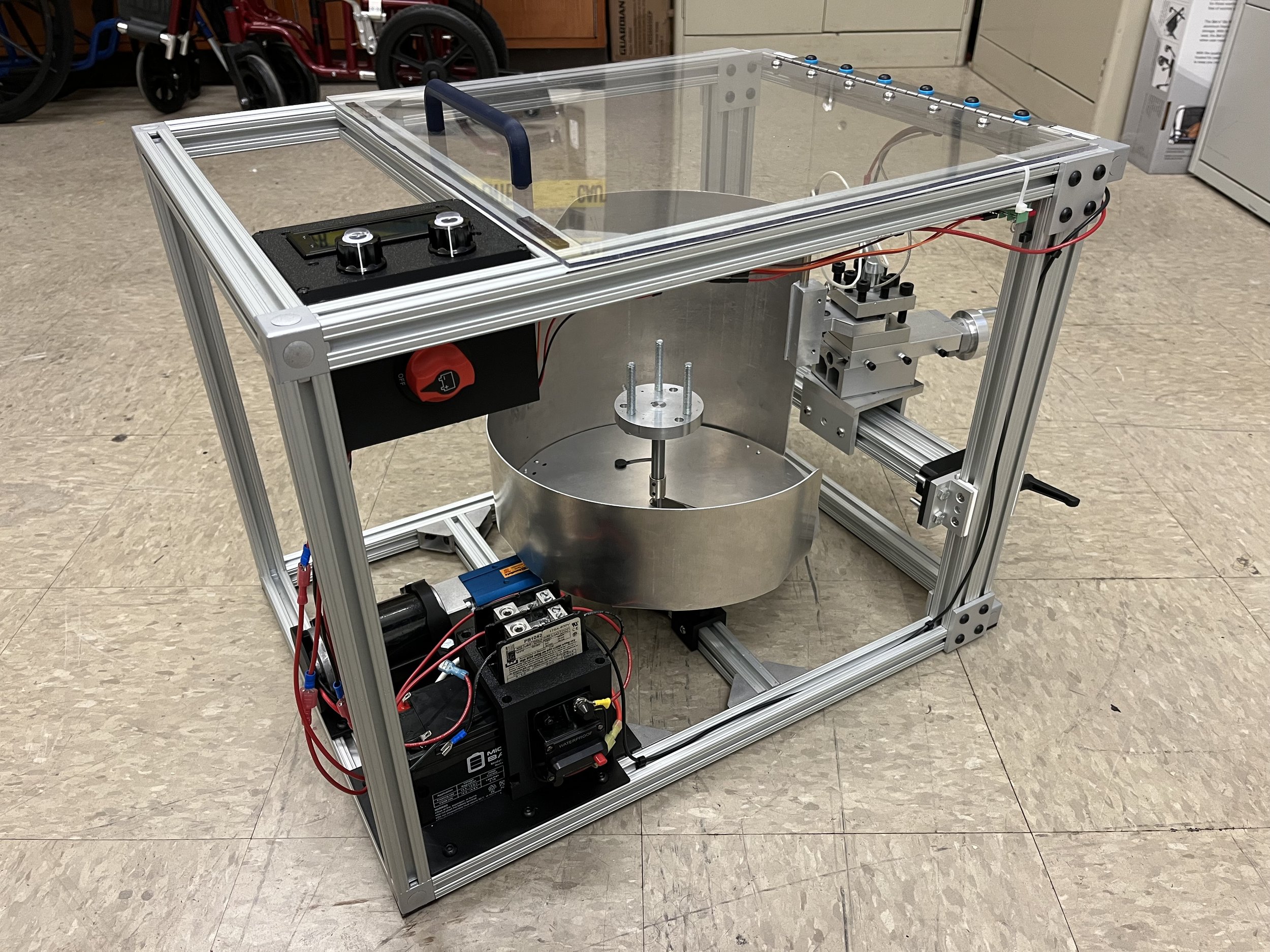
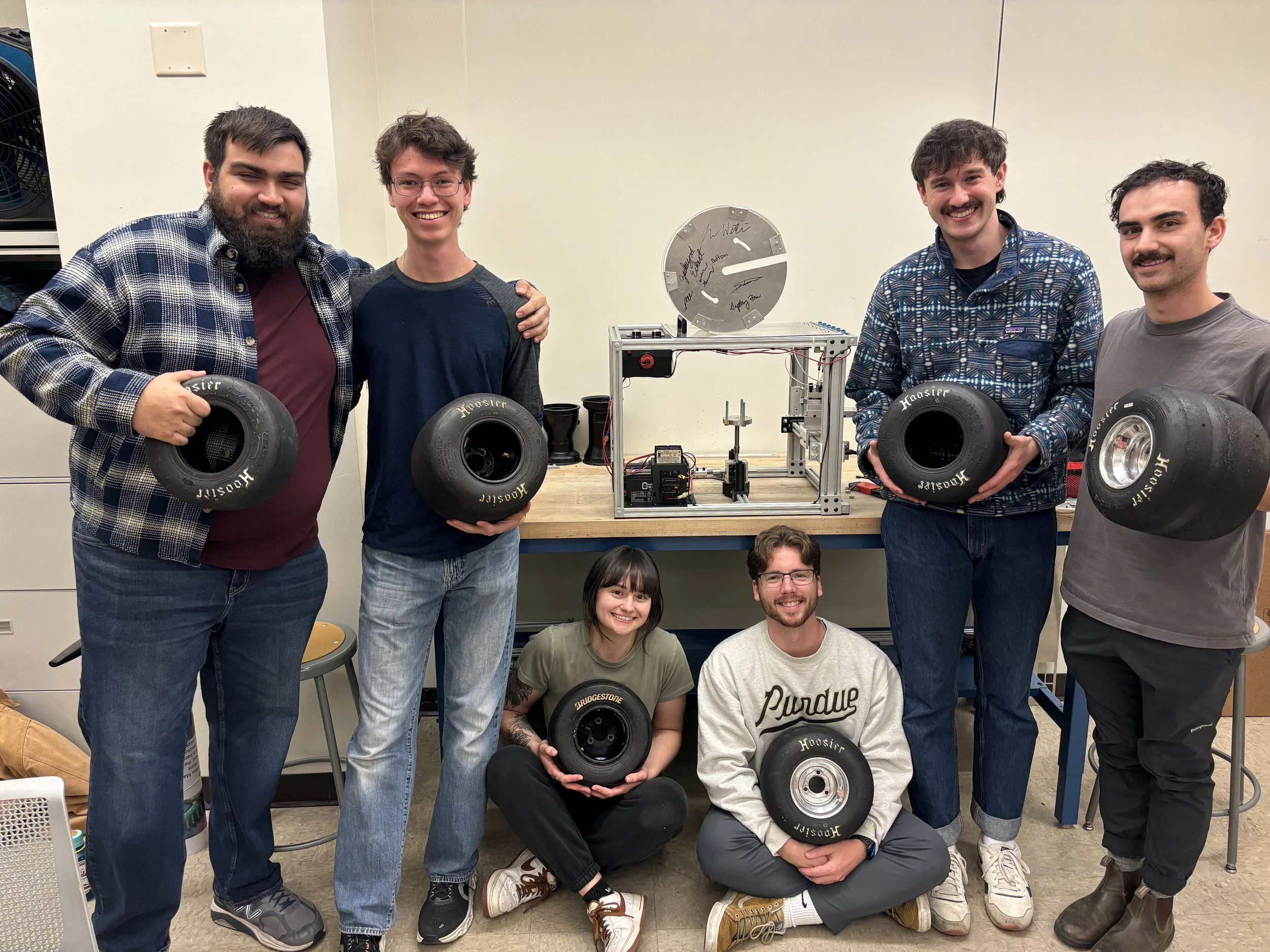
Tire scraping is used across various forms of car racing that involves a person scraping off excess rubber and debris from racing tires in an effort to increase its longevity. Unfortunately, current methods involve taxing manual labor in often unsafe conditions, with the most common method involving physically scraping debris using a blow torch and putty knife. For my capstone project, a team of six students, including myself, wanted to work with local go-kart racing teams on campus to create a new tire scrapping product that is more time efficient, cost effective, and above all, safe for the user to operate.
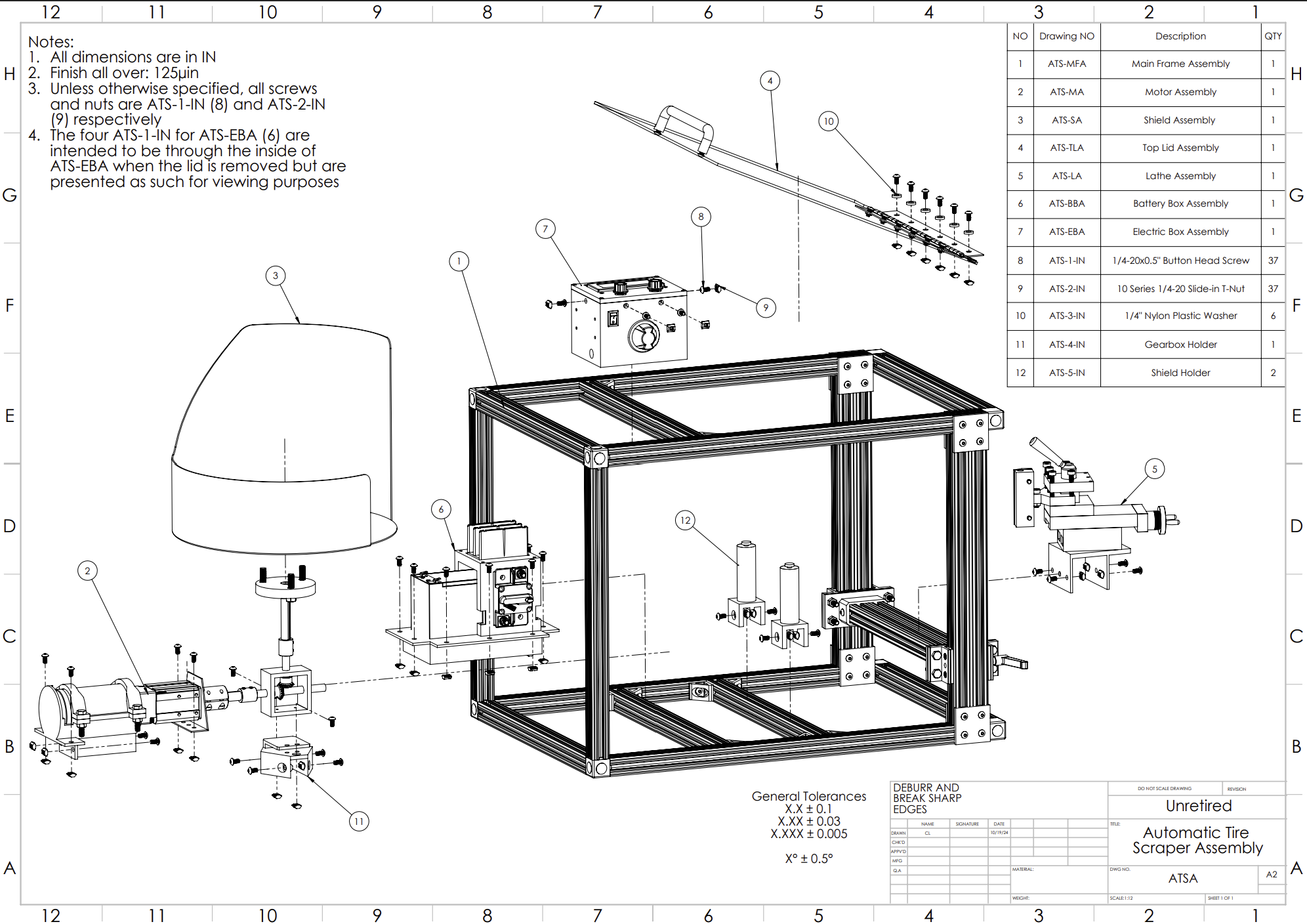
Our idea was to attach a tire to a gear motor shaft coupler assembly, which would then rotate the tire clockwise at a speed determined by the user, contained into an aluminum frame. An internally heated blade would then be pushed inwards at a certain depth to scrape the excess material off the tire. The motor speed, blade temperature, and scraping depth would all be determined based on user preference.
As the 3D modeling lead for the project, I used SolidWorks to model all the components that would need to be manufactured or bought. Additionally, I used the models to preform FEA on the tire operation speed to ensure the blade would not snap upon contact with the tire in a worst case scenario.
During the capstone project presentation, our team became one of the top five finalists for the Mallot Innovation Awards.

Extracurricular Projects
Boilermaker Rube Goldberg Team
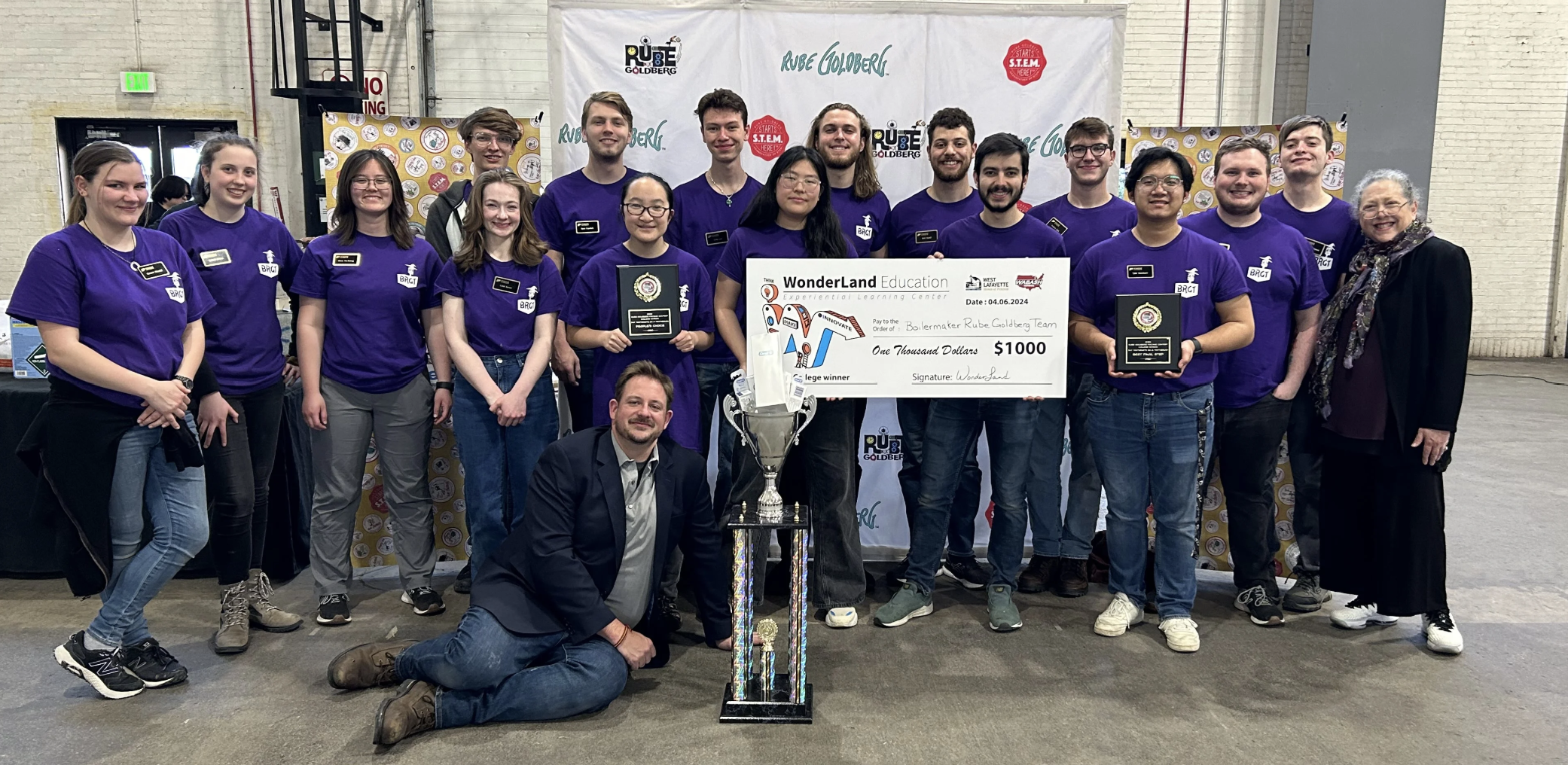
Between 2020 and 2024 I was a member of the Boilermaker Rube Goldberg Team (BRGT), which is a small group of students that builds elaborately intricate and themed Rube Goldberg machines for a national collegiate competition every year. During my time with the BRGT, I was elected as assistant project manager (what we called the First Mate) for the 2023 competition and later elected project manager (the Captain) for the 2024 competition.
The BRGT participated and won first place in the 2022 and 2023 Purdue National Chain Reaction Competition. Later, the BRGT won first place in the 2024 Rube Goldberg Machine Competition collegiate division, as well as the “Best Last Step” and “People’s Choice” awards.
Over a wide variety of steps, prototypes, transfers of energy, and frame structures I had worked on, here are a few of my favorites.
Ert the Dragon (2022)
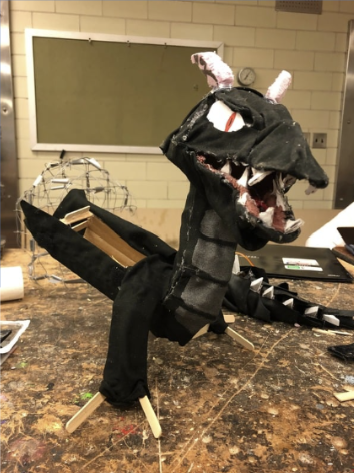
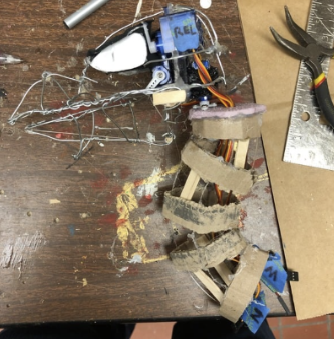
For the 2022 competition the team decided to make a machine themed around Vikings and dragons to complete the given final task of putting a hat on a head. For this machine, one of the steps I designed an animatronic dragon the team named Ert. I took inspiration from Rube Goldberg cartoons that included animals interacting with elements of the machine, which led to a falling fishing basket waking Ert from his slumber, jumping out of his cave, and feasting on a nearby fish. Ert was constructed using metal wire, popsicle sticks, carboard, small foam pieces, and t-shirt cloth. The tail section and the upper torso were split into two sections and connected by a pulley system so when Ert was awakened, the tail would move into the cave and the body would move outwards, making the illusion of one big figure. In total, Ert had 5 functions; his neck swivel, mouth, blinking eyelids, and tail wag, all controlled using servos and an Arduino Uno. While I am proud with the functionality of Ert, due to the restrictions of the competition the materials I used for construction had to be found with everyday objects, making his structure very frail. At the end of the project, I learned how important material choice can be and how to manage space for components like wires, power sources, and overall show space.
Magic and Fantasy Base Structure (2024)
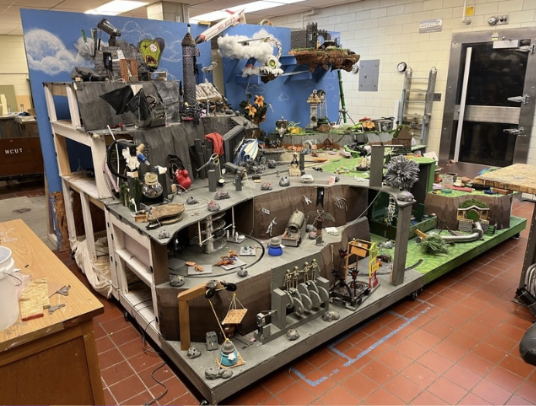
For the 2024 RGMC, the given final task was to put toothpaste on a toothbrush. The BRGT decided to do a magic/fantasy theme were all the people and creatures are tooth brush related, with the wizard villain being coated with elephant toothpaste at the end.
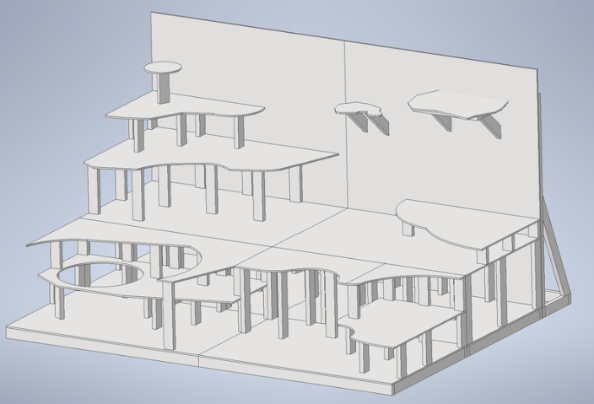
As the Captain of the BRGT, it was my responsibility to design the base structure for which the other team members would mount their steps on. The base was initially modeled in Inventor to determine the overall size and how much material would need to be purchased. At a volume of 12ft x 10ft x 11ft, the base had six different themed areas. The adventure would start in an enchanted forest, traveling deep into the mines, moving high into the mountains, stumbling across a chaotic battlefield, arriving to a village, and lastly upwards into a ruined sky kingdom. During the construction process, I understood that I am not an expert at every aspect of assembly, like with wiring or painting. I had to learn how to work alongside people with those expertise, trust their own processes, and divert resources to those areas of design when needed.
Personal Projects
Animatronics
Something that has always fascinated me is the ability to give inanimate objects the illusion of life, with the biggest fascination being with animatronics. From small scale basic functions to massive life size, fluent humanoid motion figures, each one serves a specific purpose in telling a wider story. Since there were not specific classes or clubs that are dedicated to making these figures, I decided to attempt to make a few for myself.
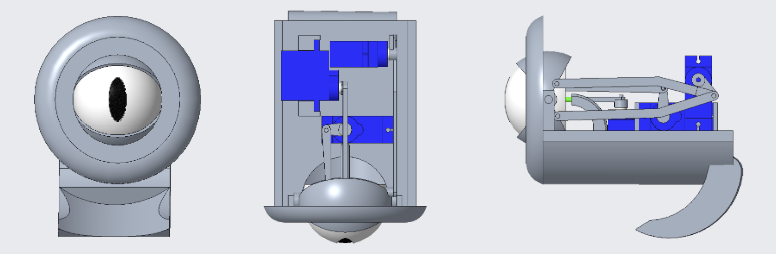
I started in early 2024 utilizing some of the CAD software I had learned in other curriculum, I attempted to model a basic figure with a focus on eye movement. Using Creo, I designed a small structure to mount servos on and an eye the size of a ping pong ball (20mm in diameter) to see how small I could make this animatronic without compromising functionality. The final prototype design can be seen in the video, with pitch and yaw eye movement, as well as a blinking function. Due to the accessibility to manufacturing methods at the time, this was as far as the prototype had made, but was still a huge milestone for understanding size limits, future cable management, and linkage movements.
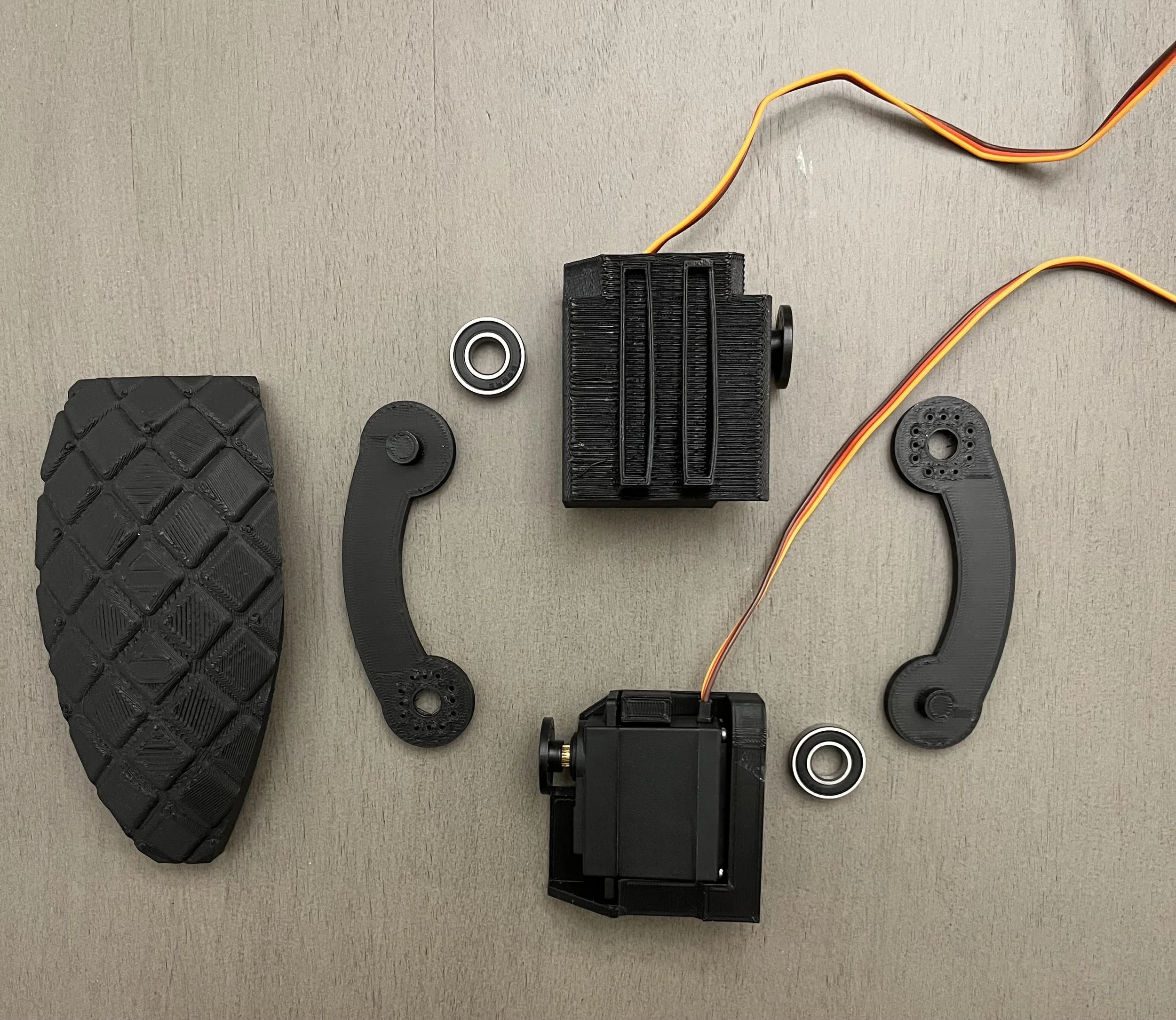
When I gained access to a 3D printer, I wanted to design an animatronic that would not be tied down to a power source, but could be put anywhere and potentially walk around similar to the BD-X droids at Galaxy’s Edge. After struggling to find inspiration and looking at a pineapple I had on my kitchen counter, I decided to make a tri-pedal crab that could turn into a pineapple when it felt threatened or for camouflage. I started to model the Pinecrabple in SolidWorks, focusing on how the legs would function and leaving room a battery pack and Arduino Nano in its core. Unfortunately, I have learned to back up your projects the hard way, as I have lost the SolidWorks files. However, I am adamantly working on recreating the files and improving on the previous design.
Creo Articulation
Pinecrabple